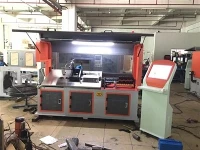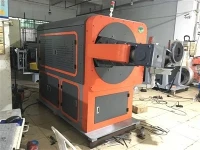


The Multi-Axis CNC Wire Bending Machine forms wire components requiring multiple bends, controlled wire rotation and 2D or 3D geometries. Servo-controlled feeding, rotation and forming movements are coordinated through the CNC system.
For wholesale buyers, the machine should be selected from the finished-part drawing, wire specification and production requirement rather than axis count alone.
Why Multi-Axis Configuration Matters
The number of CNC axes determines how many forming movements can be coordinated during one bending sequence.
2D parts: A simpler configuration may be sufficient when all bends remain on one plane.
Multi-plane parts: Wire rotation controls the material orientation before bends in different directions.
3D parts: Additional forming movements allow more complex geometries to be produced in a programmed sequence.
Close bend spacing: Tool position and clearance become important when bends are located close together.
Mixed production: CNC programs can be changed or recalled for different part geometries.
The correct configuration depends on the actual forming sequence, not simply the number of axes.
Key Machine Features
CNC-Controlled Forming
The CNC system controls programmed feeding, wire rotation and forming movements. Parameters can be adjusted according to the finished-part geometry and production requirements.
Servo Wire Feeding
Servo-controlled feeding positions the wire before each forming operation. Comparable CNC wire-forming machines commonly specify a 0.01 mm minimum feed command and programmed feed lengths of up to 10,000 mm.
The feed command increment is not the same as finished-part tolerance. Actual dimensional results depend on wire straightness, material condition, tooling, machine adjustment and part geometry.
Controlled Wire Rotation
Wire rotation changes the orientation of the material between forming operations. This is particularly important for 3D parts because the orientation of one bend affects the position of subsequent bends.
Multiple Forming Axes
Comparable machines are available in 10-, 12- and higher-axis configurations. Additional forming movements provide more options for multi-plane and complex wire forming.
Axis requirements should be determined from the actual part drawing and forming sequence.
Application-Specific Tooling
Bending fingers, guides, cutters and other tools are selected according to wire diameter, material, bend radius and part geometry. A machine suitable for a certain wire diameter is not automatically suitable for every part made from that wire.
Assembly and Testing
Production includes machining, assembly, electrical connection, adjustment and running tests before shipment. For non-standard applications, sample forming can be arranged to check the forming sequence and tooling arrangement before finalizing the machine configuration.
Technical Specifications
The following figures are industry reference ranges for comparable multi-axis CNC wire-forming machines. Final specifications should be confirmed for the selected model.
|
Item |
Typical Specification |
|
Machine type |
Multi-Axis CNC Wire Bending / Forming Machine |
|
CNC axes |
10–12 axes; higher configurations available |
|
Common wire diameter |
Approx. 0.4–6.0 mm |
|
Larger machine range |
Approx. 6–12 mm |
|
Forming |
2D / 3D wire bending and forming |
|
Minimum feed command |
0.01 mm |
|
Maximum programmed feed length |
Up to 10,000 mm |
|
Maximum feeding speed |
Approx. 80–120 m/min, depending on model |
|
Wire material |
Carbon steel, stainless steel and other formable wire |
|
Feeding |
Servo-controlled |
|
Wire rotation |
Servo-controlled, depending on configuration |
|
Program storage |
2,000+ programs on some comparable systems |
|
Total servo power |
Approx. 13–55 kW, depending on capacity |
|
Electrical supply |
Commonly 380 V / 50 Hz / 3 Ph |
|
Tooling |
Standard and application-specific |
|
Pre-shipment testing |
Running and functional checks |
These are industry reference ranges, not fixed specifications for every machine. Material hardness, wire diameter, part geometry, tooling and required production speed should be evaluated together.
Typical Applications
Automotive Components
Brackets, retainers, clips, seat-wire components and other parts requiring repeated or multi-plane bends.
Electrical and Electronic Parts
Wire clips, retaining components, mounting supports and wire brackets where bend position and orientation must be controlled.
Furniture and Wire Structures
Frames, hooks, supports and structural wire components within the selected machine's working range.
Hardware and Industrial Parts
Hooks, handles, clips, brackets, retainers and customized wire fittings. Complex parts should be reviewed for bend sequence, tool clearance and cutting requirements.
How to Select the Right Configuration
For technical evaluation, provide:
Wire diameter
Material grade
Tensile strength or hardness, if available
Finished-part drawing or sample
Overall dimensions
Number and position of bends
Bend angles and radii
Minimum bend spacing
Required tolerance
Production quantity
Cutting requirements
Destination voltage, frequency and phase
A complete drawing allows the forming sequence, axis configuration and tooling arrangement to be evaluated before quotation.
Sample Testing Before a Wholesale Order
For non-standard wire parts, sample forming can be carried out using the buyer's wire and finished-part drawing or sample. The trial helps verify the forming sequence, tooling arrangement and suitability of the proposed configuration before a larger equipment order.
Packing & Delivery
Export Packaging
Machines are packed in standard export wooden cases for international transportation. Packing arrangements can be confirmed according to machine dimensions and destination.
Sea or Air Shipment
The machine can be shipped by sea or air according to the destination and delivery schedule.
The factory works with its own freight-forwarding resources and can check shipment information during transportation. Buyers may also nominate their own freight forwarder. The factory can coordinate with the nominated forwarder regarding pickup, packing, shipping documents and loading.
Delivery Time
The standard delivery time is approximately 6–10 days after receipt of the deposit, subject to the final machine configuration, tooling and order details.
FAQ
Q: Does a higher axis count always mean a better machine?
A: No. Axis requirements depend on the number and direction of forming movements. Simple 2D parts may require fewer coordinated movements than complex 3D parts.
Q: What wire diameter can the machine process?
A: Comparable 12-axis machines commonly cover approximately 0.4–6.0 mm, while larger configurations can cover approximately 6–12 mm. Actual capacity depends on material, hardness, tooling and part geometry.
Q: Does a 0.01 mm feed command mean 0.01 mm finished-part tolerance?
A: No. It refers to the feed command increment. Finished-part accuracy also depends on wire condition, tooling, machine adjustment and geometry.
Q: Can the machine produce both 2D and 3D wire parts?
A: Yes, when the selected axis configuration and tooling provide the required forming movements. The finished-part drawing should be reviewed before confirming the machine.
Q: Can our wire and sample be tested before ordering?
A: For new or non-standard applications, sample forming can be arranged to evaluate the forming sequence, tooling arrangement and machine suitability.
Q: What information is needed for an RFQ?
A: Provide the wire diameter, material grade, hardness or tensile strength, finished-part drawing, bend dimensions, tolerance, production quantity and destination electrical standard.
Request a Technical Evaluation
Send the wire diameter, material specification and finished-part drawing or sample. The forming sequence, machine configuration and tooling requirements can then be reviewed before quotation.
Hot Tags: multi-axis cnc wire bending machine, China multi-axis cnc wire bending machine manufacturers, suppliers, factory, 2D Wire Bending Machine for Automotive Parts