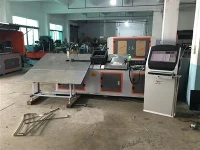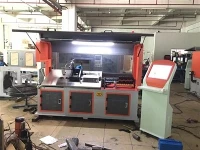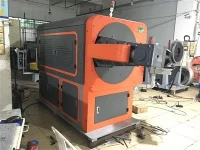


A CNC steel wire bending machine automatically feeds, rotates, bends and cuts steel wire according to programmed dimensions and forming positions. It is used for repeat production of 2D and 3D wire components where consistent bend positions and controlled forming are required.
The practical working range depends on wire diameter, material grade, tensile strength, bend radius, part geometry and production requirements. A nominal Ø3–10 mm range does not mean every 10 mm steel wire can be processed under the same conditions.
For wholesale orders, a finished-part drawing or sample provides the most reliable basis for confirming machine configuration and tooling.
Key Product Features
CNC Multi-Axis Forming
Multi-axis CNC control coordinates wire feeding, rotation and bending movements. This allows multiple forming positions and changes in direction to be programmed for 3D wire components.
The required number of axes depends on the actual forming movements. A simple 2D component may require fewer controlled movements than a complex 3D part.
Servo-Controlled Wire Feeding
Servo feeding controls the programmed wire length between forming positions. Accurate feeding is important because errors in wire length directly affect the position of subsequent bends.
Comparable industrial machines commonly specify feeding accuracy around ±0.1 mm per 300 mm under defined conditions. Actual results depend on wire straightness, material condition, machine setup and measurement method.
Programmable Bending
Bend positions, angles and production parameters can be stored in the CNC control system. Established programs can be recalled for repeat production, reducing repeated manual setup between batches.
Adjustable Production Speed
Comparable CNC wire bending machines commonly specify maximum feeding speeds around 80–100 m/min, depending on machine size and configuration. Some published models specify approximately 90 m/min.
Maximum feeding speed should not be treated as actual parts-per-minute output. Parts with many bends, short bend spacing or high-strength material may require a lower production speed.
Material-Dependent Working Range
The workable diameter changes with material strength. Soft steel wire can generally be processed at a larger diameter than high-strength or hardened wire on the same machine class.
For applications near the machine's working limit, actual wire material should be evaluated before the configuration is finalized.
Technical Specifications
|
Item |
Reference Specification |
|
Machine type |
CNC steel wire bending machine |
|
Forming method |
2D / 3D CNC wire bending |
|
Applicable wire diameter |
Ø3–10 mm |
|
Hard-wire range |
Ø3–6/8 mm |
|
Number of control axes |
5–8 axes |
|
Maximum feeding speed |
Up to 90 m/min |
|
Feeding accuracy |
±0.1 mm / 300 mm |
|
Bending angle accuracy |
±0.1°–0.2° |
|
Bending stroke |
500–850 mm |
|
Wire feeding |
Automatic servo-controlled feeding |
|
Wire rotation |
Servo-controlled |
|
Wire cutting |
Automatic |
|
Main drive |
Servo motors |
|
Control system |
CNC |
|
Program storage |
Yes |
|
Automatic wire feeder |
Available |
|
Feeder load |
1,500 kg |
|
Feeder disc diameter |
Ø1,600–1,900 mm |
|
Installed power |
7–20 kW |
|
Power supply |
380 V, 50 Hz, 3 phase; other voltages available |
|
Machine weight |
Approx. 2,000–4,500 kg |
|
Machine frame |
Welded steel structure |
|
Certification |
CE / ISO 9001 manufacturing system |
Machine Selection: What Should Be Checked?
The machine should be selected from the actual workpiece rather than wire diameter alone.
Wire diameter: Confirm the actual diameter and tolerance.
Material: Provide the material grade and tensile strength, especially for high-strength steel wire.
Part geometry: Check whether the component is 2D or 3D and record its overall dimensions.
Bend radius: Small radii may require greater forming force and specific tooling.
Number of bends: Bend positions and forming directions affect the required CNC configuration.
Production volume: Expected output helps determine feeding, decoiling and tooling requirements.
For an accurate machine evaluation, send the wire specification together with a finished-part drawing or sample.
Typical Applications
Automotive Wire Components
Suitable applications can include seat-frame wires, support wires, retaining components, formed brackets and other repeat-production steel-wire parts.
Furniture and Storage
Typical products include basket frames, rack frames, hooks, support wires and display fixtures.
Industrial Hardware
Applications can include formed brackets, support frames, retaining components and customized steel-wire parts within the confirmed machine working range.
OEM Wire Products
Manufacturers producing multiple wire products can store different CNC programs and recall established parameters for repeat orders. Tooling or setup changes may still be required when wire diameter, material or forming geometry changes.
Actual Wire Bending Test
For a new or non-standard application, sample bending with the customer's actual wire can be arranged before a bulk equipment order.
The test can evaluate:
Wire and material suitability
Machine configuration
Required forming tooling
Bend positions and geometry
Production speed
Finished-part dimensions
A test record can include the wire diameter, material grade, tensile strength, bend radius, number of bends, machine configuration, tooling and measured finished-part dimensions.
Testing the actual wire and part geometry provides a stronger basis for confirming machine suitability than using the nominal wire diameter alone.
Manufacturing and Pre-Shipment Testing
Machine production includes machining, frame assembly, installation of feeding and forming components, electrical connection, adjustment and running tests.
Relevant production processes use machining centers, wire-cutting machines, milling machines, lathes, drilling equipment and welding equipment. After assembly, the machine is adjusted and operated before shipment to check its basic working condition.
For wholesale orders, the following items can be confirmed before dispatch:
Machine model and CNC axis configuration
Wire working range
Electrical specification
Servo and control configuration
Standard and optional tooling
Automatic feeder configuration
Spare-parts list
Operation and maintenance documents
Pre-shipment test requirements
Export packing requirements
Packaging & Delivery
The machine is packed in a standard export wooden case suitable for international transportation.
Sea and air freight can be arranged according to the machine size, delivery schedule and buyer's requirements. A regular freight-forwarding partner can assist with shipment coordination and provide updated delivery information during transportation.
Buyers can also appoint their own freight forwarder. The factory can coordinate with the buyer's nominated forwarder to arrange pickup, loading and shipping documentation.
Standard delivery time: 6–10 days after receipt of the deposit, subject to the confirmed machine configuration, tooling requirements and production schedule.
The final delivery terms, shipping method and estimated transit time should be confirmed in the quotation or purchase order.
FAQ
Q: What steel wire diameter can this machine process?
A: The reference range is approximately Ø3–10 mm for suitable configurations. The actual range depends on material grade, tensile strength, bend radius, part geometry and the selected machine model.
Q: Can it bend high-tensile steel wire?
A: It depends on the actual wire strength, diameter and finished-part geometry. High-strength wire requires greater forming force and may reduce the practical diameter range.
Q: Can the machine produce 3D wire components?
A: Yes. Suitable multi-axis configurations can rotate and bend wire in different directions. The required axis arrangement depends on the forming movements shown in the finished-part drawing.
Q: What is the normal feeding speed?
A: Comparable machines commonly specify maximum feeding speeds around 80–100 m/min. Actual production speed depends on wire material, diameter, bend count, bend spacing and tooling.
Q: Can one machine produce different wire products?
A: Yes. Different CNC programs can be stored for repeat products. Changing wire diameter, material or forming geometry may require different tooling or machine adjustments.
Q: What information is required for a wholesale quotation?
A: Provide the wire diameter, material grade, tensile strength, finished-part drawing or sample, bend positions, radii, dimensional tolerance, production quantity and local electrical requirements. These details allow the machine configuration and tooling requirements to be evaluated before quotation.
Request a Technical Evaluation
Send the wire diameter, material grade, tensile strength and finished-part drawing or sample.
The machine configuration, working range, tooling requirements and testing method can then be evaluated against the actual wire component.
For non-standard parts, sample bending before a bulk equipment order can provide a practical basis for confirming machine suitability.
Hot Tags: cnc steel wire bending machine, China cnc steel wire bending machine manufacturers, suppliers, factory, 2D Wire Bending Machine for Automotive Parts